Millcroft : How Fighting the Battle Became the Point.

By Rowen Fraser
The loss of the Millcroft Golf Course should force Burlington to ask an uncomfortable question:
“Did our political leaders do everything possible to preserve the golf course or did the fight itself eventually become more important than finding a way to save it?”
I believe that question deserves serious examination.
For years, Mayor Marianne Meed Ward and Ward 6 Councillor Angelo Bentivegna have presented themselves as defenders of Millcroft's remaining green space. Council formally opposed the original development, and in 2024 the Ontario Land Tribunal nevertheless approved redevelopment of part of the golf-course lands. The City publicly expressed its disappointment and continued to oppose the loss of green space. Those facts are important, but opposition is not the same thing as achieving an outcome.
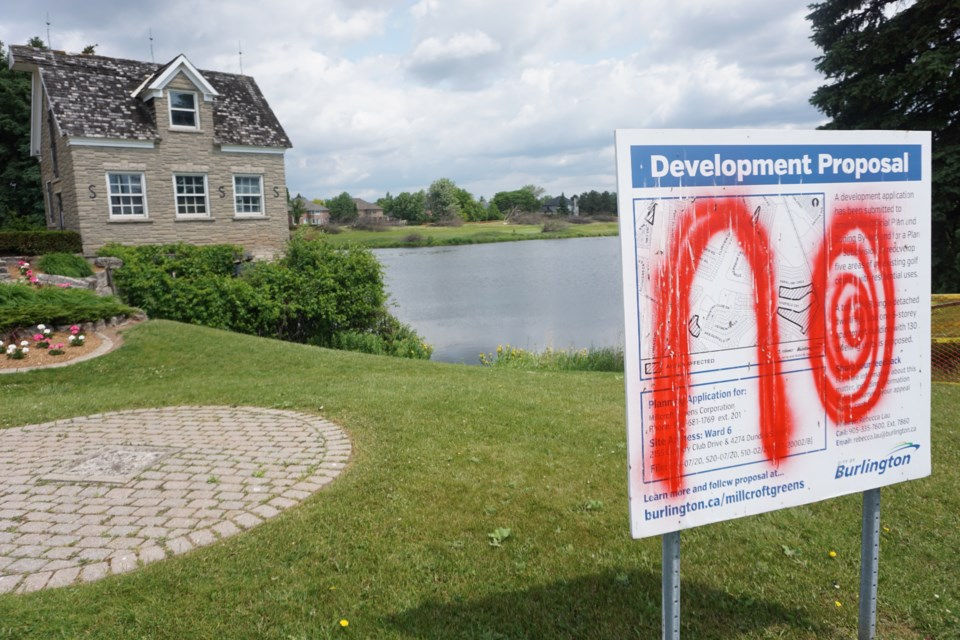
Today, residents are looking at a golf course that is already being developed in part, with a further Phase 2 proposal now before the city involving 138 residential lots on additional portions of the remaining lands.
That is the uncomfortable reality for the residents of Millcroft.
Could the course have been saved?
I don't believe residents should simply accept the answer that there was nothing more that could have been done. There were many opportunities for negotiation.
In June 2025, Argo indicated that it was interested in discussing the sale of up to 70 acres of the remaining golf-course land for nominal consideration if an agreeable development scenario could be reached on the balance. The Mayor and Councillor Bentivegna subsequently confirmed that the offer could be discussed through the provincial facilitation process.
That was an opportunity.
The City and developer then entered a provincially facilitated process intended to explore whether housing and an integrated parks and open-space system could coexist on the remaining lands. That process concluded in December 2025 without consensus.
That was another opportunity.
In early 2026, the City pursued a potential purchase of the remaining lands. The City has since confirmed that staff contacted the owner about purchasing all or part of those lands for $15 million, approximately three times the amount the golf course had been purchased for in 2020. ARGO declined to sell at that price. This was a desperate move by the city. They told nobody about their intent to spend that massive chunk of money. If we talked about what it represented as a net city-side tax increase that would be about 5%. That isn't necessarily how they would have paid for it, but that is the amount of our money they would spend to dig themselves out of a hole they dug. Regardless, the gravity of the situation had sunk in. They had botched the negotiation badly, and made the development significantly more difficulty both legally and financially.
Off to a great start!
The politics of saying "no"
There is an understandable political appeal to taking an uncompromising position.
You can say “We fought the developer for YOU.”
You can point to council votes, tribunal hearings, provincial correspondence, MZO requests, public statements, and inflate your own ego with your own self importance at the same time!
You can continue fighting to absolutely no end.
Governing, however, is ultimately about outcomes. The public does not own a stack of council resolutions. It owns the consequences of the decisions made by its government. If the consequence of years of political confrontation is that the community loses the very landscape everyone said they were fighting to protect, residents are entitled to ask whether a different strategy could have produced a different result. That does not mean the City should have surrendered. It means negotiation should have been treated as a means to an outcome rather than as evidence of political weakness.
It is unfortunate when egos get in the way of progress.
When the fight becomes the legacy
This is where I worry the Millcroft story has become less about solving a problem and more about preserving a political narrative.
The narrative is simple:
"We fought.
We opposed development.
We challenged the province.
We challenged the developer.
We kept fighting."
But residents ultimately have to judge government by what happened to the land.
There is a danger in turning political opposition into a kind of martyrdom, where losing becomes evidence of how hard you fought rather than a reason to examine whether the strategy worked.
I am not suggesting that the Mayor or Councillor deliberately wanted to lose the golf course. The public record does not establish that. I am suggesting good intentions are not enough when the stakes are this high. If a strategy produces a worse result than another available strategy might have produced, elected officials should be willing to acknowledge that possibility.
The Irony of Millcroft
The irony is difficult to escape.
The golf course was defended as something uniquely valuable to the neighborhood: green space, storm water function, open space and a defining part of Millcroft's character. The City itself has described the remaining lands as important to preserving parks and open space.
Yet the community is now confronting development on the golf-course lands.
Phase 1 has already been approved through the OLT process.
Phase 2 is now under review.
And the developer has separately sought a provincial MZO for the remaining lands. I would like to point out however that was only in response to Burlington's MZO request before any negotiations for phase 2 were even undertaken. Here in Burlington our mayor wields the MZO like a toddler wields a sledgehammer. Whatever one's politics, this is not the outcome residents were promised by the rhetoric of “saving” Millcroft.
That distinction matters.
Residents were entitled to expect more than a fight. They were entitled to expect a strategy capable of producing results.
We need a different question
The question should no longer simply be “who fought hardest?”
Instead we should ask “Who was prepared to do whatever was necessary including negotiate, compromise, purchase, partner and find creative solutions to preserve as much of Millcroft as possible?”
Those are very different standards. They lead to a very different conversation about leadership. I believe the golf course represented something worth saving. I also believe that saving it required more than declarations of opposition. It required strategy, negotiation, and recognizing opportunities when they appeared. Above all, it required keeping the desired outcome of preserving the land ahead of the political value of being seen fighting for it.
The residents of Millcroft deserve an honest accounting of whether every realistic avenue was pursued, when those opportunities arose, what was offered, what was rejected, and why. Because once the fairways are gone and the houses are built, political explanations won't restore them.
The land will be the legacy.
That is the standard by which the decisions surrounding Millcroft should ultimately be remembered.
For a better understanding of how we got here check out my blog


Comments